

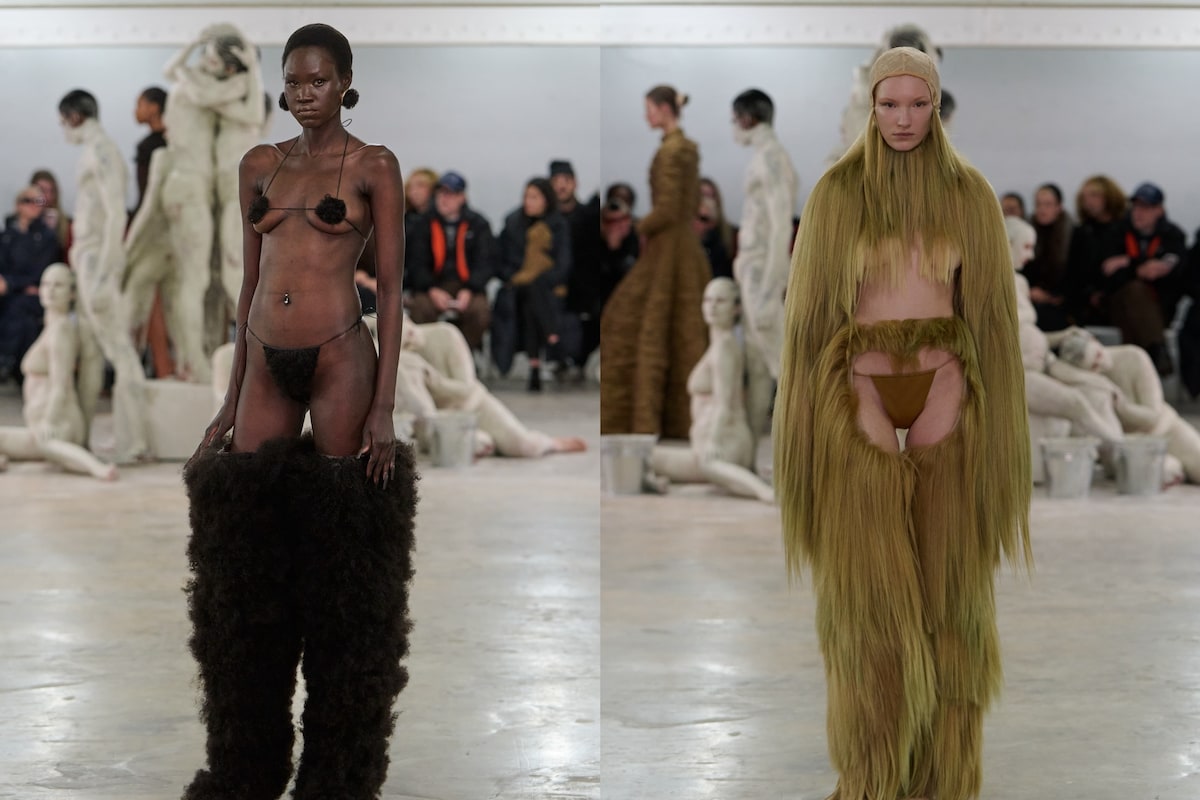
Hair has always flirted with fashion, but on rare occasions it becomes the fashion. According to a backstage report by Kristen Bateman for Dazed Beauty, boundary-pushing hair artist Charlie Le Mindu has returned to the catwalk for SS26 with a collection described as “hairy, furry, bushy” — an evocative reminder that hair can operate as material, silhouette and statement, not just styling. In an industry where runway hair is often tasked with polishing a designer’s vision, Le Mindu’s work flips the hierarchy: hair is the couture, and the show becomes a living gallery of texture, movement and provocation.
Why Le Mindu’s return matters for runway hair
Dazed’s piece frames Le Mindu’s SS26 moment as a full-bodied return to the catwalk — and in doing so, spotlights an important shift in how hair artistry is being valued. Within UK fashion and session styling, the “best” runway hair can sometimes be invisible: clean, controlled and camera-ready. Hair couture, by contrast, insists on presence. It asks the viewer to consider fibre, density, shape and engineering in the same way they’d assess tailoring, drape or embellishment.
That matters culturally as much as it does aesthetically. Hair is loaded with identity and storytelling — from personal style to heritage — and when a hair artist leads a collection, the medium itself becomes the message. Le Mindu’s textured, exaggerated approach also mirrors a broader appetite for tactile beauty: audiences are increasingly drawn to looks that feel crafted by hand, not flattened by uniform trends.
For readers watching the UK beauty space, the practical implication is clear: even if hair couture isn’t your everyday wardrobe, the techniques behind it (strategic texture placement, controlled volume, sculptural finishing) influence what filters down into mainstream editorial styling, salon requests and social content.
“Hairy, furry, bushy”: decoding the texture story
The Dazed summary leans on three words — “hairy, furry, bushy” — each signalling a different texture language. “Hairy” suggests visible strands and deliberate roughness rather than polished perfection. “Furry” hints at softness and plush density, potentially referencing hair-as-fabric and a deliberately tactile surface. “Bushy” speaks to volume and expansion: hair that takes up space and claims attention.
In professional terms, these descriptors map to familiar runway priorities: create impact at distance, read clearly on camera, and move convincingly under lights. The difference is that hair couture pushes these priorities to an extreme, demanding an elevated level of preparation and control — particularly around structure, weight distribution and how hair sits against a moving body.
For everyday hair, you can borrow the spirit without the spectacle: embrace non-uniform texture, let volume be directional rather than symmetrical, and treat finishing as a creative decision (glossy vs matte, soft vs separated, airy vs dense).
What this signals for UK hair trends beyond the catwalk
Runway moments like SS26 hair couture don’t translate literally to the high street — and they’re not meant to. But they are trend engines. When a show makes hair the headline, it nudges the industry in a few predictable directions:
- Texture as luxury: not just sleek shine, but beautifully controlled movement, separation and “realness”.
- Volume without uniformity: shapes that look styled, yet not overly symmetrical or overly smoothed.
- Craft-forward hair: a renewed appreciation for time, technique and a visible “handmade” quality.
- Hair-as-accessory: oversized silhouettes and statement elements where hair competes with garments for attention.
There’s also a subtle, important takeaway for salon culture: clients increasingly arrive with references that are more editorial than practical. Translating a dramatic runway concept into a wearable cut, colour or style is where a trusted stylist earns their keep — by preserving the mood while adjusting for hair density, curl pattern, porosity and lifestyle.
One real-world next step: if you’re tempted by the “bushy” energy, ask for a consultation focused on shape rather than just length — for example, how internal layers, perimeter weight and styling habits can create volume that suits your face shape and daily routine.
How to channel hair couture energy in a wearable way
You don’t need a catwalk call time to enjoy the confidence of hair that feels bold and intentional. Many session stylists recommend starting with a clear decision: do you want your hair to read as soft, textured or sculpted? Once you choose, the routine becomes simpler — because every step supports the same finish.
- For a “furry” soft-focus finish: prioritise touchable conditioning and a gentle, flexible hold so hair moves rather than sets rigidly.
- For “hairy” separated texture: work in small sections and finish with light, directional styling that encourages visible piece-y definition.
- For “bushy” volume: build lift at the roots, then keep the mid-lengths light so the shape expands without collapsing.
- For sculptural impact: think in silhouettes—where do you want width, height or asymmetry—and style to that outline.
- Protect the integrity: editorial looks often rely on repeated heat or backcombing; balancing statement styling with conditioning and gentle detangling helps keep hair resilient.
Hairporium’s editorial stance is always to treat inspiration as a starting point, not a prescription: the most successful translation of runway hair is the version that works with your hair’s natural behaviour, not against it.
Key Takeaways
- Charlie Le Mindu’s SS26 return, as reported by Dazed, positions hair as couture material — not just a styling finish.
- “Hairy, furry, bushy” points to a texture-first aesthetic built on visible strands, plush density and statement volume.
- Hair couture often influences mainstream trends indirectly: more texture, more craft, and bolder silhouettes in editorial and salon styling.
- Wearable versions come from choosing a finish (soft, textured, sculpted) and building your routine around it.
- Practical next step: bring one runway reference to your stylist and ask how to translate the shape and texture for your hair type and routine.
Frequently Asked Questions
What is “hair couture”?
Hair couture is hair artistry presented with the ambition and craftsmanship of haute couture fashion — using hair as a main design material to create silhouettes, textures and dramatic concepts.
Is runway “hair couture” meant to be worn day-to-day?
Usually not in a literal sense. Its purpose is to push creative boundaries. However, elements like texture placement, volume and finishing ideas often influence wearable salon and editorial trends.
How can I try a runway-inspired textured look without damaging my hair?
Keep heat and backcombing occasional, detangle gently, and prioritise conditioning. Many stylists suggest limiting high-tension styling and giving hair recovery days between heavy looks.
Which hair types work best for bold, bushy volume?
Any hair type can create volume, but techniques vary. Fine hair often benefits from lightweight lift and careful shaping, while thicker or curlier hair may rely more on controlled moisture and shrinkage management.
What should I ask for in the salon if I love this aesthetic?
Ask for a consultation focused on shape and texture: where you want volume to sit, how you style at home, and what kind of finish (soft vs separated vs sculpted) you want most days.
Explore More: Discover related reads from Hairporium — News • Guides • DIYs • Expert Articles.
Stay Updated: Read more UK hair industry news and innovations on Hairporium News.


More in Hair news
FKA twigs’ Grammys hair look fused a bold basketweave structure with spiked loc styling—an editor...
A wig coming loose in the ring has renewed attention on how hair systems cope with sweat, frictio...
A Lincolnshire hairdresser marks a year in business with team growth and a new skills academy, re...
Jarrell Miller’s mid-fight “hair malfunction” went viral — but it’s also a lesson in how hair sys...
Catherine, Princess of Wales, has quietly swapped her signature loose curls for a sleeker, more p...
A UK tribunal decision reported by The Independent found severe baldness can meet the disability ...
A UK ruling arising from a wigs VAT appeal highlights that severe hair loss can, in context, be r...
Barry Keoghan’s Ringo Starr-inspired haircut is more than a celebrity switch-up: it’s a mastercla...
Barry Keoghan’s mop-top debut for his Ringo Starr role has renewed interest in 60s hair. We break...
The award-winning play Jaja’s African Hair Braiding comes to London, bringing braiding-salon cult...
View all hair news